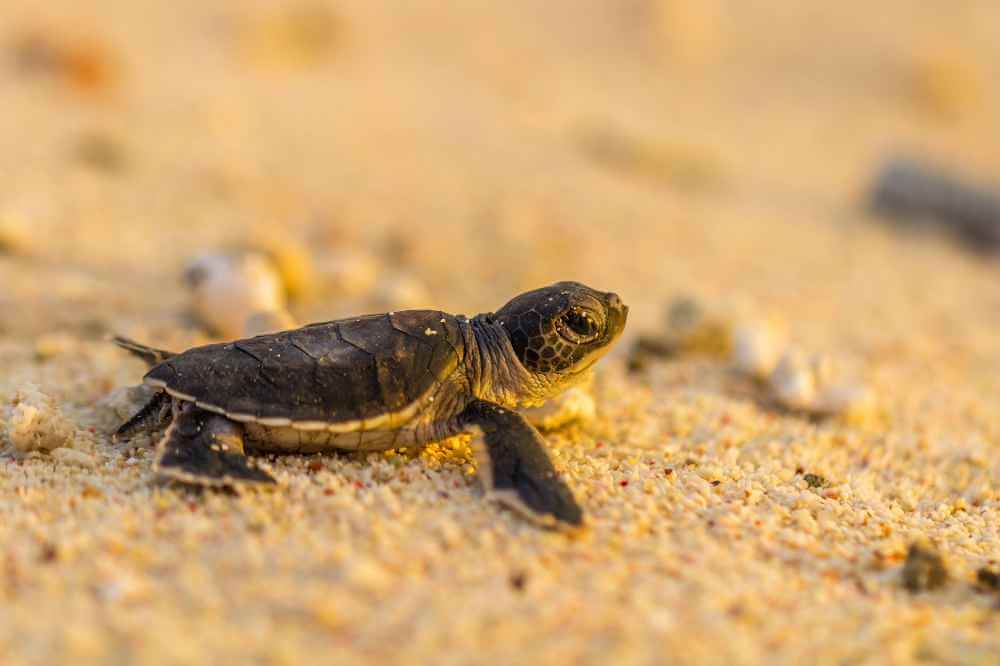
Every summer at Topsail Island off the coast of North Carolina, a hundred or so sea turtles crawl from the ocean to the foot of the island’s sandy dunes to lay their eggs. Their nests are easy to spot, at least to the occasional vacationer. A group of dedicated volunteers places a wire grate over the nests to protect the eggs from predators while waiting approximately 60-70 days for them to hatch. The nests are staked out and marked with bright orange tape to prevent them from being disturbed.
Last week, during our family beach vacation, the nests began to hatch. I checked on two different nests throughout the week, and then, one night, the sand in one of the nests had “dropped,” suggesting an imminent boil—the emergence of the baby turtles. Topsail Turtle Project staff and volunteers smoothed the sand between the nest and the ocean to make the journey these tiny turtles would have to undertake as easy and successful as possible, and, at about 9:30 p.m, we witnessed about 100 baby turtles rush to the waves. Volunteers only intervened by us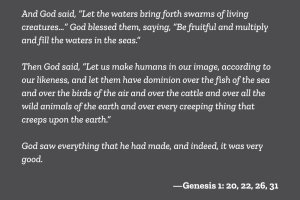 ing small piles of sand to redirect the turtles who had veered off course.
As I witnessed the careful and protective work of these volunteers throughout the week, I was reminded of God’s instructions to human beings in the book of Genesis to “have dominion over the fish of the sea.” That word dominion is tricky; it evokes images of control and oppression, and yet the Hebrew word connotes a certain amount of responsibility and care. This responsibility was manifested in the care of sea turtles last week, while my understanding of what it means to care for creation expanded to include the literal care of creatures (rather than, say, the traditional practices of reducing, reusing, and recycling—though these are, of course, important).
As I think back to the way the Topsail Turtle Project volunteers carefully and dutifully keep vigil by the turtle nests all summer long, I can’t help but imagine God doing the same—not oppressing us, but anxiously waiting for life to erupt from our frames, smoothing the way for us, and gently redirecting us when we stray. The responsibility of caring for creation certainly begins with God and then flows through us.
This September, ELCA congregations will have the opportunity to observe, using assigned Scripture readings and prayers, a new liturgical festival called Creation in Christ. Just this past April, the Consultation on Common Texts (the group that works on our Sunday lectionary readings) established this new festival after several years of ecumenical conversations. As an ELCA blog post suggests, the festival “celebrates God as Creator and ponders the great mystery that everything was created through Christ. And, as a result, it also inspires us to care for the gift of the created world” (“Creation in Christ” Annual Observance). I hope the congregations of this synod will latch onto this new festival, for in acknowledging the ways we can care for creation, we might also begin to discover the vast ways God cares for us.
In a world we are told is threatened by microplastics, the care of creation has never felt so vital. As we approach the Creation in Christ feast, may we not only confess to our neglect of creation, but also acknowledge the opportunities we have to tend to all that God has given us, as well as God’s own care for all that God has made.
O God, in whom we live and move and have our being, in Christ you created the worlds, and your Spirit breathes life into the universe. We praise you for your wondrous creation. Bless us and all your handiwork with your infinite light, and direct our lives to the care of this good earth, through your Son, Jesus Christ, our Savior and Lord. Amen.
~Prayer of the Day for Creation in Christ
Together in Christ,

NC Synod Bishop