
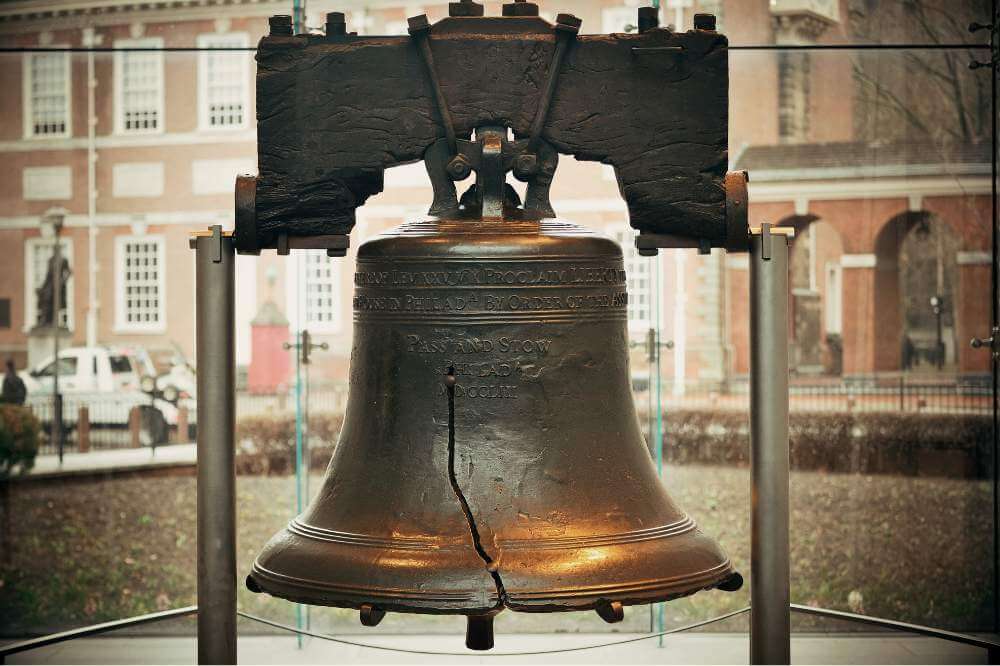

During a recent trip to Philadelphia for vacation, our family visited the Liberty Bell. (Yes, we timed our visit to coincide with the 250th anniversary of our country.)
Originally installed in the 1750s over the State House in Philadelphia (now Independence Hall—where the Declaration of Independence was signed), it was removed in 1846 when its famous crack could not successfully be repaired.
The Liberty Bell is a symbol of the American Revolution. It is a symbol of liberties gained and a reminder of liberties denied.
It is a relic of the nation’s beginning.
It has inspired and challenged visitors, especially in times of crisis.
Its outline, familiar throughout the world, conveys the idea of the continuing expansion of liberty to new peoples and into new aspects of life.
—plaque at the Liberty Bell Center in Philadelphia
The inscription at the top of the bronze bell reads: Proclaim Liberty Throughout All the Land Unto All the Inhabitants thereof, which is a quote from the book of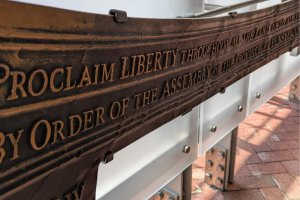 Leviticus, as Moses provides a list of “best practices” for how the people of God should go about living together. Proclaiming liberty was an essential part of what was called the Year of Jubilee, where the people of God would allow the earth to rest, forgive one another’s debts, and release any enslaved people or servants.
In the Gospel of Luke, Jesus references this Jubilee when he stands in the synagogue to read from the prophet Isaiah: The Spirit of the Lord is upon me, because he has anointed me to bring good news to the poor. He has sent me to proclaim release to the captives and recovery of sight to the blind, to set free those who are oppressed, to proclaim the year of the Lord’s favor. (Luke 4:18-19)
Abolitionists in the 1800s would soon cling to the inscription on the bell, understanding (and advocating for) liberty to apply to all people. In fact, the Liberty Bell did not become the “Liberty Bell” until the abolitionists renamed it such—it was just the “State House Bell” until then. And yet, the abolitionists discovered in a founding symbol of our country, the hope and dream of liberty for all people.
In his treatise, On the Freedom of a Christian, Martin Luther held, “The Christian individual is a completely free lord of all, subject to none. The Christian is a completely dutiful servant of all, subject to all.” Essentially, in Christ we are liberated from the powers of sin and death, but also liberated to love and serve our neighbor. I would argue that such neighborly love should consist of advocating for liberty for all people or, as the inscription itself states, throughout all the land unto all the inhabitants thereof.
I am proud that our country was founded on the ideal of liberty for all people. Yet I am also aware that to achieve such liberty takes great effort. I pray that our faith will continue to call us to return to that work so that true liberty is proclaimed throughout all the land unto all the inhabitants thereof.
Wengert, Timothy. J. The Freedom of a Christian 1520: The Annotated Luther Study Edition. Fortress Press, 2016.
(Inset Photo Credit: Bishop Emily Hartner)
Together in Christ,